
For years, students were often encouraged to follow a familiar career path: finish school, attend college and pursue a skilled profession in fields such as technology, finance, medicine or management.
But the job market is changing.
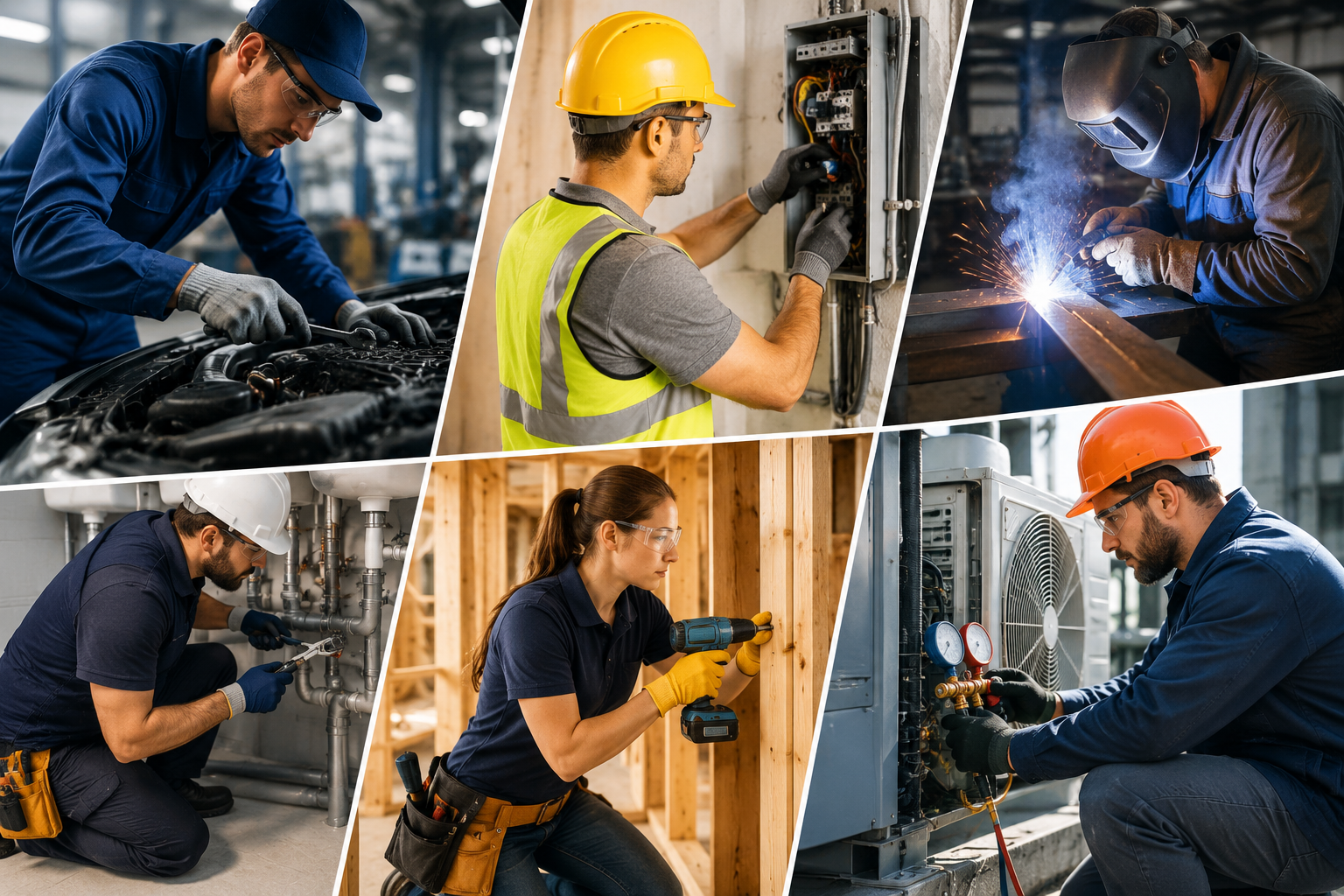
Across many economies, skilled trades are attracting renewed attention as employers struggle to find qualified workers in areas such as electrical work, plumbing, welding, construction, HVAC, industrial maintenance and specialised manufacturing.
These jobs can require technical training rather than a traditional four-year university degree, and some experienced tradespeople can earn highly competitive incomes.
So why are skilled trades becoming more attractive—and in some cases, more lucrative?
The skilled-worker shortage
One of the biggest reasons is simple supply and demand.
Many experienced tradespeople are approaching retirement, while fewer young workers are entering some traditional trade occupations.
This creates a gap between the number of workers employers need and the number of qualified people available.
The U.S. Bureau of Labor Statistics continues to project significant employment opportunities across a range of construction and installation occupations, while infrastructure, manufacturing and building activity continue to require workers with specialised technical skills. (bls.gov)
When qualified workers are difficult to find, employers may have to offer better wages, benefits and career opportunities to attract and retain them.
Not every trade requires a university degree
A major attraction of skilled trades is the alternative education pathway.
Many occupations require apprenticeships, vocational programmes, technical certificates or on-the-job training rather than a conventional four-year degree.
An apprentice can learn practical skills while gaining workplace experience, and some apprenticeship programmes allow workers to earn money during training.
This can dramatically change the economics of entering a career.
A young person may avoid several years of university tuition while simultaneously developing a skill that employers urgently need.
That does not mean trade careers require no education. Modern electricians, mechanics, technicians and industrial workers often need substantial technical knowledge, safety training and certification.
The difference is that the training is usually much more directly connected to the job.
Infrastructure is creating demand
Ageing infrastructure is another major factor.
Buildings, electrical networks, roads, factories, water systems and other infrastructure require continuous construction, maintenance and repair.
The expansion of renewable energy is creating additional demand for technical workers.
Solar installations, wind farms, battery-storage facilities and electric-vehicle infrastructure all require people who can install, maintain and repair complex physical systems.
The U.S. Department of Energy, for example, has highlighted the need for a growing skilled workforce to support America’s clean-energy transition. (energy.gov)
AI cannot easily replace physical skills
Artificial intelligence is transforming office-based work, but many skilled trades involve physical environments that are difficult to automate completely.
Imagine an AI system trying to repair an old electrical installation inside a building, fix a leaking pipe behind a wall or diagnose a malfunctioning industrial machine in a difficult-to-access location.
Robots can perform certain specialised tasks, but real-world environments are unpredictable.
A skilled tradesperson often has to inspect a problem, make decisions, use tools, adapt to unexpected conditions and communicate with customers or other workers.
That combination makes many trade occupations relatively resistant to complete automation.
Technology is actually changing the trades
This does not mean skilled trades are untouched by technology.
Quite the opposite.
Modern tradespeople increasingly work with sophisticated equipment, digital diagnostic systems, smart building technology, computer-controlled machinery and advanced measurement tools.
Electricians may work with smart-home systems and electric-vehicle charging infrastructure.
HVAC technicians increasingly encounter connected heating and cooling systems.
Automotive technicians use computerised diagnostic equipment to identify problems in modern vehicles.
Industrial maintenance workers may deal with robotics, sensors and automated production lines.
As technology becomes more complicated, the person maintaining it needs to become more technically skilled.
Some trades can lead to business ownership
Another advantage is the possibility of becoming self-employed.
An experienced electrician, plumber, contractor, mechanic or HVAC specialist can potentially build a private business and eventually employ other workers.
At that point, income is no longer determined solely by an hourly wage.
A successful trade business can generate revenue from multiple employees, contracts and projects.
However, entrepreneurship also brings risks. Business owners have to deal with equipment costs, insurance, taxes, marketing, employees, customer acquisition and unpredictable demand.
Skilled does not mean easy
The growing popularity of trade careers should not create the impression that these jobs are effortless.
Many skilled trades involve physically demanding work, irregular schedules, safety risks and years of practical training.
Workers may spend long periods outdoors, work in confined spaces or operate around machinery, electricity, chemicals or heavy equipment.
The financial rewards therefore need to be considered alongside the working conditions.
Why younger workers are reconsidering career choices
The rising cost of higher education is also influencing career decisions.
Students increasingly want to know whether the time and money spent obtaining a degree will translate into a strong return on investment.
A technical career that requires shorter training and allows someone to start earning earlier can be attractive.
For someone who enjoys practical problem-solving and working with their hands, a skilled trade may also offer greater job satisfaction than an office-based career.
The trades of the future may look very different
The phrase “skilled trades” once brought images of traditional construction jobs.
Today, the category is much broader.
Future opportunities could grow around:
- Electric-vehicle servicing
- Renewable-energy installation
- Industrial automation
- Robotics maintenance
- Semiconductor manufacturing
- Data-centre infrastructure
- Electrical systems
- Advanced manufacturing
- HVAC and heat-pump technology
- Smart-building systems
The expansion of AI itself could create demand for tradespeople. Data centres, semiconductor factories and energy infrastructure require enormous amounts of physical construction and maintenance.
In other words, the digital economy still needs people who can build and maintain the physical world underneath it.
Are skilled trades a better choice than college?
There is no universal answer.
Medicine, engineering, law, finance, technology and many other professions continue to offer excellent career opportunities.
The important point is that university is not the only route to a successful career.
For some people, a trade apprenticeship or technical qualification may offer a faster and more affordable path into a well-paid profession.
For others, a university degree may be essential for their chosen career.
The best choice depends on interests, abilities, financial circumstances, career goals and local job demand.
The bigger picture
The growing demand for skilled trades reflects a fundamental economic reality: the world needs people who can build, install, repair and maintain physical infrastructure.
As experienced workers retire and new technologies create additional technical requirements, the value of practical expertise could continue to rise.
For young people deciding what to do after school, that makes skilled trades worth considering alongside traditional white-collar careers.
The future of work may not belong exclusively to programmers, doctors or corporate executives.
It could also belong to the electrician wiring the next generation of buildings, the technician maintaining an automated factory, the mechanic servicing electric vehicles and the specialist keeping critical infrastructure running.
Disclaimer
This article is intended for general informational and educational purposes. Earnings and employment prospects vary significantly by occupation, location, experience, certification and employer. No career guarantees a particular salary or level of job security. Readers should research local labour-market conditions, training requirements and licensing rules before choosing a career.
Learn more about our site on contactarchive2in.com
Contact us on our email id contactarchive2in@gmail.com
Leave a Reply
You must be logged in to post a comment.