
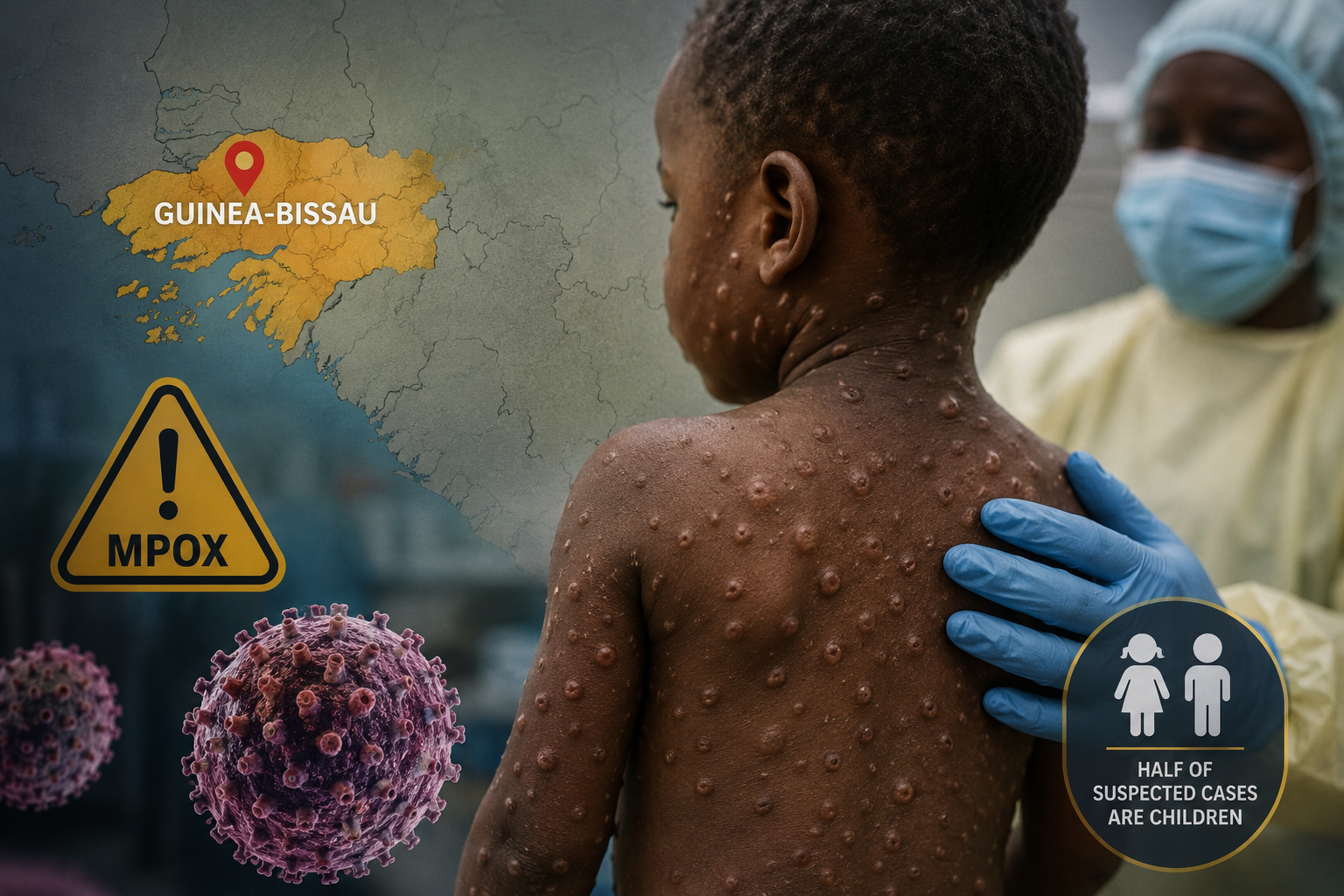
A First of Its Kind Health Emergency for Guinea Bissau
For the first time in its history, Guinea-Bissau is battling an mpox outbreak and children are bearing a disproportionate share of the burden. Of the 46 suspected cases reported so far, roughly half involve children under the age of 15, according to UNICEF. The West African nation, whose disease surveillance systems are already considered fragile, now finds itself managing an outbreak of a virus it has never previously recorded within its borders.
How the Outbreak Started
The country’s first confirmed case was announced on July 4, 2026, by Public Health Minister Quinhin Nantote. The patient was a 27-year-old woman who had first sought medical care on June 24. Health workers collected samples from lesions on her skin and sent them to Guinea-Bissau’s National Institute of Public Health (INASA) for testing. The result was later cross-verified by the Institut Pasteur in Dakar, Senegal, confirming the presence of the mpox virus.
Following that confirmation, Guinea-Bissau’s Ministry of Public Health activated national response mechanisms in line with the International Health Regulations and World Health Organization (WHO) guidance, including epidemiological investigation, contact tracing, and community awareness campaigns.
Where Things Stand Now
As of August 17, Guinea-Bissau has recorded seven confirmed mpox cases all in adults. Six of these are concentrated in the Autonomous Sector of Bissau, the capital region, with one additional case in Biombo Region. No deaths have been reported so far.
However, the confirmed case count only tells part of the story. Alongside the seven lab-confirmed infections, health authorities are tracking 46 suspected cases, and children under 15 account for roughly half of them. That’s a significant concern for public health officials, since children are considered more vulnerable to severe complications from mpox than adults.
Sandra Martins, UNICEF’s Deputy Representative in Guinea-Bissau, has pointed out that even a small outbreak becomes a major public health event in a country reporting mpox for the very first time. She has also flagged the risk that, given weak surveillance infrastructure, a number of cases particularly among children could be going undetected altogether.
Why This Matters for Children Specifically
Mpox typically spreads through close physical contact, including contact with skin lesions, body fluids, or contaminated materials like bedding and clothing. Once inside a household, transmission to children can happen easily through everyday close contact with an infected family member. Historical outbreak patterns elsewhere in Africa have similarly shown children being significantly affected once mpox begins to spread within households and communities, rather than remaining confined to the original point of introduction.
For Guinea-Bissau, this raises the stakes considerably: a fragile health system already stretched thin now has to prioritize early detection and care for a population young children that faces a higher risk of severe illness.
The Response Underway
UNICEF is working alongside Guinea-Bissau’s Ministry of Public Health, the WHO, and other partners on several fronts:
- Strengthening disease surveillance and contact tracing capabilities
- Reinforcing infection prevention and control measures, along with water, sanitation, and hygiene (WASH) practices in health facilities
- Delivering timely, accurate information to children and families to help curb further spread
- Supporting community outreach to reduce stigma associated with mpox
UNICEF has stated it requires more than US$150,000 in flexible emergency funding to carry out critical parts of its mpox response in the country funding officials describe as urgently needed to protect the most vulnerable populations.
What Families Are Being Advised to Do
Health officials are urging families in Guinea Bissau to act quickly if a child or any family member shows possible mpox symptoms, which can include:
- A skin rash or lesions
- Fever
- Swollen lymph nodes
Families noticing these signs are advised to seek medical care immediately rather than waiting, given how easily the virus can spread within close-contact settings like homes. Basic hygiene practices regular handwashing, avoiding close contact with anyone suspected of infection, and following guidance from local health authorities remain central to limiting further transmission. Reducing stigma around the disease is also being emphasized, since fear of social judgment can discourage families from coming forward for testing and care.
The Bigger Regional Picture
Guinea-Bissau’s outbreak arrives against the backdrop of a broader mpox situation across West and Central Africa, where multiple countries have reported cases in recent years, including some involving significant proportions of pediatric cases. For a country experiencing mpox for the first time, international support and rapid containment efforts are considered critical to preventing the outbreak from escalating further, particularly among children who remain the most vulnerable group.
Learn more about our site archive2in.com
Contact us on our email id contactarchive2in@gmail.com
Read out our latest blog on Swell Surge Alert for Kerala, Tamil Nadu & Lakshadweep: When Waves Born Thousands of Kilometers Away Strike Without Warning
Leave a Reply
You must be logged in to post a comment.